Showing posts with label north african. Show all posts

Monday, September 3, 2012

Kousa Sahel (Stuffed Squash or Zucchini)

National "Leave a Zucchini on your Neighbor's Doorstep Day" was August 8th. Did you miss it, this opportunity to do something with the unseemly vigorous harvest of your garden?  Or did you ignore your squash until it grew to the size of your baby?


Even if you've managed to stay ahead of the squash production with zucchini bread and stir-frys, don't give them all away.  Hold on to the small, tender ones at least and do as the resourceful Arab cook does. The zucchini or "kousa" indigenous to the Middle East is a fairer variety, in color and texture. The favored size is small,  6-8 inches in length and about 1 1/2 inches in diameter. The squash are hollowed out with an implement that I call a zucchini corer (amazon: http://www.amazon.com/s/ref=nb_sb_ss_c_0_14?url=search-alias%3Dgarden&field-keywords=zucchini+corer&sprefix=zucchini+corer%2Caps%2C184) but a combination of apple corer and paring knife can effect an approximate result - a hollow tube with seeds removed and the soft pulp scraped out to leave a shell as thin as possible. (The zucchini pulp can star in frittatas or the fritter recipe included below).  Traditionally Kousa are cooked in a large pot among layers of sliced tomato (again, your garden provides!) stuffed eggplant, with chunks of beef or lamb to infuse the kousa with flavor. The technically correct name for this dish is "Kousa Mahshi".  This version, "Kousa Sahel", is richer with a silkiness provided by the frying of the onions and zucchini.  Don't forget the lemon juice in the sauce!  It perks up the whole with a vibrant fresh contrast to the creamy sweetness of the fried onions.


Kousa Sahel (stuffed squash):
12 small zucchini squash                   1 large onion, slivered
1 lb. ground lamb or beef                  oil for frying
¾ cups rice, pre-soaked in water        4 cups fresh tomato sauce or
1 tab. salt                                                  paste to make sauce
1 tsp. pepper                                      juice of 1 lemon
¾ cup chopped parsley                      1 tsp. cinnamon
1 tsp. allspice

-Brown ground meat and season with salt, pepper, cinnamon and allspice. Drain well and set aside.
-Hollow out washed squash.  Mix drained rice with meat and parsley.  If the meat is fatty, you will not need more fat.  If not, add a tab. or two of corn oil to the mixture.  Add salt and pepper.
-Over a large bowl, stuff the squash with filling until it is loosely full to ¼ inch from the top. Lightly fry the squash in oil until the skins are browned and bubbly.
-Meanwhile, brown the onions in oil until brown.  Add the tomato sauce and lemon juice and boil for 10 minutes at a rolling boil.  Reduce the heat to simmer. Carefully lay the squash in the sauce and cook 20-30 minutes.  Cover and stir carefully from time to time.
-To serve, transfer the squash with a slotted spoon on to a platter.  Pour the thickened sauce over the squash and garnish with chopped parsley.


Wednesday, June 13, 2012

Doights de Fatma (Stuffed filo "fingers")

          Yes, they are long and thin, like fingers, but the name is more curious than descriptive and I still delight in saying it for the humorous effect. “Doights de Fatma” – fingers of Fatma (Some maintain she was the sister of the Propeht Mohammed, some say his aunt, some his daughter.) At any rate, they are “finger-lickin’ good”! 

          Traditionally, in Tunisia, malsouka wrappers are used but we can approximate the requisite crunch with buttered filo sheets. Filled with seasoned ground beef, cubed potatoes and parsley they are rolled spring-roll style then fried to a golden crisp.  Upon each bite, they delightfully crunch into flaky bits; a crunch like that created by stepping on a dried autumn leaf or biting potato chips. The sensation just makes you want tobite again! A squirt of fresh lemon juice brightens the mild parsley and garlic components and velvetizes the milkiness of the potatoes. Anisa, a wealthy adventurous Tunisian hostess, shared a lighter chicken version, the filling similar to the tajin recipe. Gruyere cheese adds a nutty sophistication to the flavors and is accented with the addition of lemon juice as well.


Doights de Fatma:
2 tab. olive oil
1 large onion, finely chopped
3 cloves garlic, minced
1 lb. lean ground beef
2 medium potatoes, cooked, peeled and diced
1/2 cups minced parsley
salt and pepper to taste
2 eggs, lightly beaten
2 dozen lumpia/malsouka wrappers or filo pastry sheets 
Oil for frying

-In large saute pan, heat 2 tab. olive oil over medium heat.  Add onion and saute for 5 minutes until onions are soft.  Add ground beef and garlic,and saute until meat is browned.  

-Remove from heat and season with salt and pepper 
and stir in potatoes, parsley and eggs.

-If using filo pastry, melt 1/2 cup butter. Place 2 sheets of filo on a dry working surface.  Brush with melted butter.  Place 1/3 cup beef mixture on the short end of pastry sheets and press filling to 3 inches in length. Roll one time, encasing filling.  Fold 1 inch of edges on each edge over filling then continue rolling tightly to create a spring roll shape.  Rolls should be about 1 - 1&1/2 inch in diameter.  Set aside, seam side down.

-If using lumpia/malsouka wrappers, place wrapper
at a time on dry work surface.  Place 1/3 cup filling 
along one edge of pastry.  Roll tightly as described 
above.  Brush edge of pastry with water and set 
doights aside.  Fry as described above. (You do not 
need to use butter with these wrappers.)

-Heat 2 inches of oil in frying pan until hot (a bread 
cube should brown within 30 seconds)and place 
doights seam side down in oil. Fry over medium-high heat, turning until rolls are golden on all sides.  Pull rolls from grease with tongs and allow extra oil to drip back into the pan.  Set on paper towels to drain and cool slightly.

-Serve warm with fresh lemon wedges. 

Anissa's Chicken Doights de Fatma
2 cups shredded cooked chicken  
2 cloves garlic, minced
1 large onion, finely chopped
2 eggs
1 cup shredded Swiss or Gruyere cheese
1 cup cubed cooked potato
1/2 cup chopped parsley
salt and pepper to taste
1/2 cup butter
2 dozen lumpia/malsouka wrappers of filo pastry

-Saute onion and garlic in 2 tab. oil until transparent.  Stir in chicken.  Beat egg and add to chicken mixture. Cook and scramble over medium heat until egg is lightly cooked.  Cool mixture.  Stir in salt and pepper, cheese potato and parsley.  

-If using filo pastry, melt 1/2 cup butter. Place 2 
sheets of filo on a dry working surface.  Brush with
melted butter.  Place 1/3 cup chicken mixture on the
short end of pastry sheets and press to about 3 inchein length.  Roll one time, encasing filling.  Fold 1 inch of edges on each side over filling then continue rolling tightly to create a spring roll shape.  Rolls should be about 1 - 1 1/2 inch in diameter.  Set aside, seam side down.

-Heat 2 inches of oil in frying pan until hot (a bread 
cube should brown within 30 seconds) and place 
doights seam side down in oil. Fry over medium-high heat, turning until rolls are golden on all sides.  Pull rolls from grease with tongs and allow extra oil to drip back into the pan.  Set on paper towels.

-Serve warm with fresh lemon wedges. 

Sunday, May 13, 2012

Tunisian Almond Phyllo "Snake"

Almond Phyllo Snake

If Amal knew how to make filo pastry, she never showed me how. I suspect
the truth is that her mother had never made it and that with the coming of
mechanization, even her grandmother dropped her rolling pin, dusted off her
hands and raised them to heaven with exclamations of "Il hum-dil-allah"! (Praise God). Can you imagine rolling and stretching a dough of flour and water to the prescribed 1/32 of an inch thickness, let alone the counter space required? 

So this is one pastry we don't make just like grandma did, although you too, can become adept at reaching for the boxes of frozen filo in the back of the grocery store freezer section to select the perfect one (the boxes in the front tend to be older and somewhat dried out). Melted butter is filo pastry's "partner in the
sublime" and accounts for the buttery, golden crunch of the final product!


Finicky Fillo:
(secrets I have discovered about the pastry in our long association, beginning with the meat filled rolls prepared for my wedding!)
*Be sure phyllo is completely thawed before using. It may be kept in the fridge up to a week or in the freezer for up to 3 months.
*Don't work with phyllo when you are in a hurry with 5 minutes to spare have a grumpy toddler pulling on your leg or workmen are drilling in your basement. Though not difficult the separation of the paper thin layers can be tedious and a calm spirit tends to a neater result!
*Unroll phyllo and lay the stack of pastry sheets flat on work surface. Keep stack loosely covered with plastic wrap to prevent drying out as you work with the individual sheets.
*Brush all exposed surfaces of the pastry with melted butter, including tops, bottoms and sides of shaped and completed dish. Though margarine can be used and some recipes opt for olive oil or cooking spray, please don't use anything but butter - and certainly don't offer me any if made with anything else - a persnickety cook indeed!
*Score pastry before baking if served in pieces with a sharp, serrated knife,
then cut again through the scorings after baking. (The almond snake is
an exception - do not score before baking.)
*Alas, you will not have success freezing phyllo dishes after they have been baked...they lose their crunch and morph into a heavy, soggy version of their former glorious selves. However, some dishes do well if frozen before baking, such as baklawa. It can be prepared, thoroughly brushed with butter and covered with foil. Uncover and set out for 20 - 30 minutes and bake as directed. Filo dishes are best stored at room temperature only lightly covered with foil. No airtight containers or plastic bags or there goes the crunch!


Almond Filo Snake
1 cup ground almonds (in food processor)
1/2 cup sliced almonds, toasted
1 1/2 cups powdered sugar
1 egg, separated
2 tsp. finely grated lemon rind
1 tsp. almond extract
1/2 cup melted butter
24 sheets phyllo pastry
Pinch of ground cinnamon
Powdered sugar to dust

-Preheat the oven to 350 degrees.  Lightly grease an 8-inch round pan.

-Place the ground almonds in a bowl with the powdered sugar.  Put the egg white in a bowl and lightly beat with a fork.  Add to the almonds with the lemon rind, and extract.  Mix well.

-Remove 2 sheets of  phyllo and cover the rest with plastic wrap to prevent it drying out.  Brush the phyllo sheets with butter, then cover with 2 more sheets and butter, repeat one more time with 2 more sheets of phyllo, using a total of 6 sheets.  Spread 1/4 of almond mixture along the length of the buttered pastry and roll up to enclose the filling.  Form into a coil and set the coil in the center of the pan.  Make 3 more snakes and use butter to join to the other rolls and continue shaping to make a large coil.

-Add the cinnamon to the egg yolk and brush over the snake.  Bake for 30 minutes.  Let cool for 10 minutes then dust with powdered sugar, sprinkle with toasted sliced almonds and serve cut in wedges.  

(The snake will keep for up to 3 days but should not be refrigerated.)

Thursday, May 3, 2012

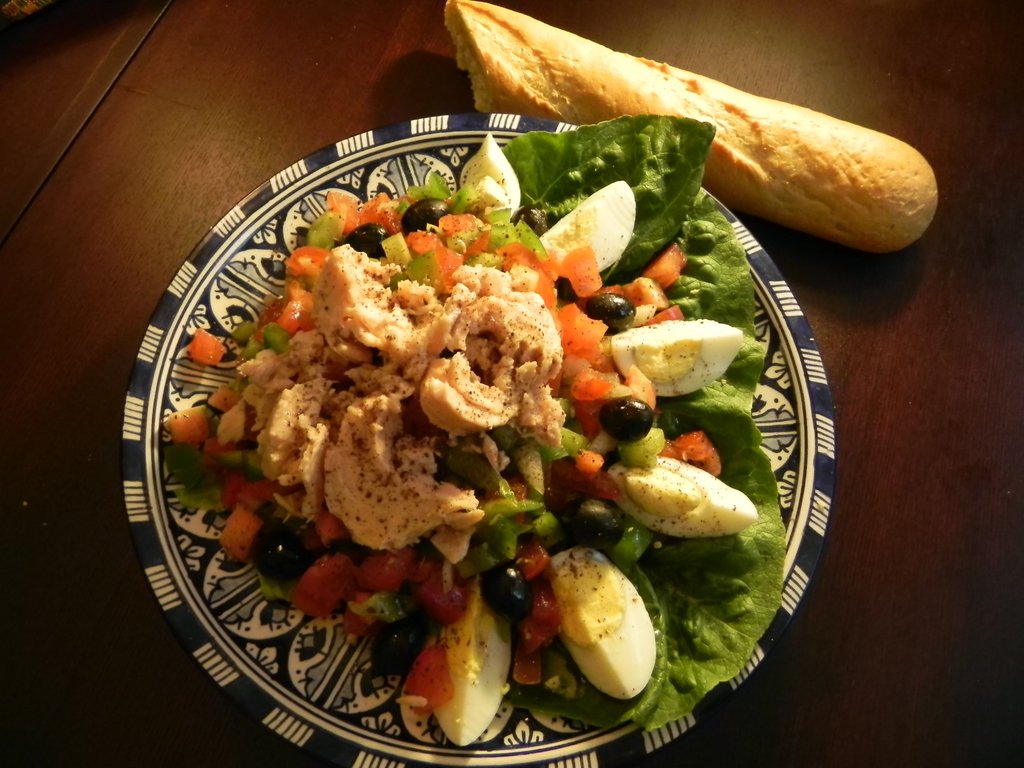
Tunisian Salad

Tunisian Salad

     My mother said Sabiha, our "bonne", watered down the dish-detergent, my mother-in-law said she stole her mumu, my husband said please don’t let her cook, but I did anyway, one night each week. The dishes were always interesting – cous-cous sewn up in sheep stomach for example, and often delicious – Tajin Malsouka (see the recipe on this blog) a more appetizing example.  

      Among the less exotic, entrail-entailed, was Tunisian Salad, which my mother in-law as well as husband grudgingly noted as one of Sabiha’s talents, and forgave her her thievery.  Most often, a dish prepared from emerald green peppers, meaty tomatoes, onion and garlic (never dried but purchased fresh on the stock with soft purplish skins), the addition of olives, tuna and boiled eggs, elevate this salad to a meal. French baquette is the utensil used to sop up the salad and to this day I must eat salad dressed with vinaigrette with crusty French bread. When the basic ingredients didn’t volunteer themselves in the kitchen, Sabiha scoured the flower garden for leaves that spoke to her of digestion.  Though hesitant and wondering if she had any axes to grind with me, I found that the UFV was delicious.  

      I have searched the gardens of my various homes in the years since, for the same leaf but I thought it must be a uniquely Tunisian citizen.  In my current home however, I discovered it one day growing happily and abundantly among my potted plants - purslane - considered a weed in the U.S. it is commonly used in other cuisines - including mine, now that I know where to find it!  It is mildly peppery and salty, a flavor akin to spinach and just what Tunisian Salad requires.
 
      In Tunis, I quickly learned the words for survival at the produce stand from my husband the linguist, chief among them “piquant”  for hot and "doux' for mild.  The boxes of emerald jewel peppers all looked the same to me, varying only in shape and the vegetable merchants, hoping the Americans would shop another day, kept their axes unground if they had any, by directing me to the milder varieties.  Sabiha taught me to roast veggies on the flame of the gas burner and peel the scorched skins to create Salata Mechouia,  first cousin to Salata Tunsia. The smokiness of the roasted vegetables velvetized with olive oil and lemon juice became my favorite but I was always happy to be in control of how much "piquant" pepper was used!


Salata Tunsia  (Tunisian Salad)  
4 large roma or plum tomatoes, chopped
2 large sweet green peppers, chopped
1 small hot green pepper, finely chopped
1/2 medium yellow onion, finely chopped
3 cloves garlic, minced
2 eggs, hard-boiled and quartered lengthwise
1 tab. tabil (see recipe http://www.foodandwine.com/recipes/tabil-spice-mix)
1/3 cup olive oil
1 1/2 tsp. salt
freshly ground black pepper
2 tab. fresh lemon juice
1 can light chunk tuna or albacore, drained
10 - 15 mediteranean type olives
Romaine lettuce leaves

-In medium bowl, combine tomatoes, peppers, onion and garlic.  Sprinkle lightly with salt and allow to sit for 15 minutes.  Drain excess liquid from vegetables.  In a small bowl, mix tabil, olive oil, lemon juice and salt and pepper.  Pour over vegetables and toss.  Chill for 30 minutes.  On a serving platter, arrange romaine lettuce leaves.  Mound vegetable mixture on the leaves, then top with tuna chunks.  Arrange eggs and olives around edges.  Drizzle with additional olive oil and sprinkle with paprika or sumac.  Serve with a fresh, crusty baguette.  Serves 4 - 6.  

Monday, April 23, 2012

Tajin Malsouka (Tunisian Quiche)


Tajin Malsouka  

        Proud to share my Tunisian culinary triumph with my mentors, I proclaimed one day that I had made tajin but I had not used the prescribed parsley, as “the cupboard was bare”. I was told in no uncertain terms, that I had not made “Tajin” – an important lesson in my tutorial. Parsley is not simply an accent. It is a star ingredient! In repentance of my err, I have not neglected parsley since, being grateful that I can employ the busy fingers of my children in picking the leaves form the bitter stems – my “Parsley Pickers” extraordinaire.

       Akin to the Moroccan version in name only, Tunisian Tajin more accurately resembles a quiche of potatoes, chicken, swiss cheese….and oh, parsley! Americans use bread, Mexicans the tortilla, Asians the eggroll wrapper, to encase whatever lovelies are in want of a blanket. Tunisians use malsouka, a paper thin water/flour pastry, similar to a crepe, most notably used in the national pastry brik – another day, another entry. Malsouka sheets provide a delicate, crunchy casing for meat, fish, and vegetables as well as sweet, nutty fillings.


Tajin Malsouka
2 cups shredded cooked chicken  
1 cup shredded Swiss cheese
2 cloves garlic, minced                    
1 cup cubed cooked potato
1 large onion, chopped                    
½ cup chopped parsley
2 eggs                                                   
2 dozen lumpia/malsouka wrappers or filo pastry
½ cup butter                                         
salt and pepper to taste

-Saute onion and garlic in 2 tab. oil until transparent.  Stir in chicken.  Beat  eggs and add to chicken mixture. Cook and scramble over medium heat until egg is cooked.  Cool mixture.  Stir in salt and pepper, cheese, potato and parsley.  Salt and pepper to taste.

-If using filo pastry, melt butter.  Place 2 sheets of filo on a buttered pizza pan and brush with melted butter.  Place another 2 sheets on top in a pinwheel effect and brush with butter.  Continue brushing and layering until you have used 8 sheets.  Place the chicken mixture on top. 

-Fold the overlapping filo over the top of the filling.  Place 2 sheets of filo over the top and brush with butter.  Continue to layer buttered filo over the top in the same pinwheel effect until you have used 8 sheets.  Tuck the overhanging edges under the pie to form a neat round parcel.  Brush well with the remaining butter. 
 
- (If using lumpia or malsouka wrappers, place 1 wrapper at a time in bottom of  buttered 10 inch pie plate.  Butter and continue layering wrappers until 6 sheets are layered.  Mound filling in center of layered pastry.  Cover the top with 6 more wrappers, buttering each one.  Tuck the edges in around the edges of the pie.)

-Bake the pie for 40-45 minutes until golden.  Let sit 10 minutes before cutting into pie shaped or square pieces.  Serve warm or at room temperature with lemon wedges.


Wednesday, September 7, 2011

Tunisian Cous-Cous

       She knocked at the door where the new Americans had moved in and said she wanted to practice her English.  Nadia was 18 years old, a beautiful, delightful, outgoing Tunisian, daughter in a large family in the neighborhood near the vegetable market, with a mother and sister who loved to cook - she hooked me with that!  They taught me, the adventure-struck expat, to make Cous-Cous, the national dish of the Maghreb (North Africa).  I taught them to make brownies and apple pie and always felt that I made out better in the deal.

      Cous-Cous to Tunisians implies the main dish staple, smothered in a piquant meat and vegetable, tomato based stew.  No such frou-frou as Lemon Glazed Oxtail Cous-Cous Salad.  The following authentic version uses beef, though chicken, fish and a spicy local sausage, merguez, often appear as the star.  Cous-cous is a hearty, soul-soothing, family dish, just exotic enough to pique the adventurous palette, but tame enough to temper finicky appetites.  Cook it low and slow to let the flavors meld.


Tunisian Beef Cous-Cous

1 package couscous
5 cups water
1/3 cup olive oil
1 tab. sugar
2 pounds chuck steak, cut in 2-inch cubes
2 beef bouillon cubes (or 1 whole chicken, cut into pieces)
2 medium potatoes, peeled and cut
1 large onion, sliced into 2-inch cubes
3 cloves garlic, minced
2 large carrots, peeled and cut in 1-inch lengths
2 tsp. salt
½ tsp. pepper
1 cup peeled, cubed banana
1 tab. cardamom or acorn squash
1 tab. powdered cumin
2 hot peppers, quartered (opt)
dash cayenne pepper
¾ cup tomato paste
1 tsp. crushed dried red chili peppers
1 1lb. can chickpeas, drained
2 green bell peppers, seeded, cored and quartered


-In large stew pot, heat oil and fry meat, onion and garlic, stirring until meat is brown. Add salt, pepper, cardamom, cumin, cayenne, tomato paste, dried chili peppers, water, sugar and bouillon cubes. Stir and cover. Let simmer 1 hour or until meat is almost tender. (If using chicken, remove after 30 minutes and continue simmering sauce.)

-Add potatoes, carrots, squash, chickpeas and peppers. Cover and simmer until vegetables are just barely tender, stirring occasionally. (Add more water if necessary.

-Cook couscous according to package directions.

-Arrange cooked couscous on platter and top with meat and vegetables. Pour some of the sauce over the meat and couscous. Serve remaining sauce in a separate container.

-Serves 8 – 12. (Couscous may be made with cubed lamb, chicken or white fish, if desired.)